772 proposals. And nearly half of them want to talk about agents.
The CFP is closed and the review has begun. Before the program committee disappears into it, here is what the raw submission pile looks like — by track, by format, by country, and by what people actually chose to put in their titles.
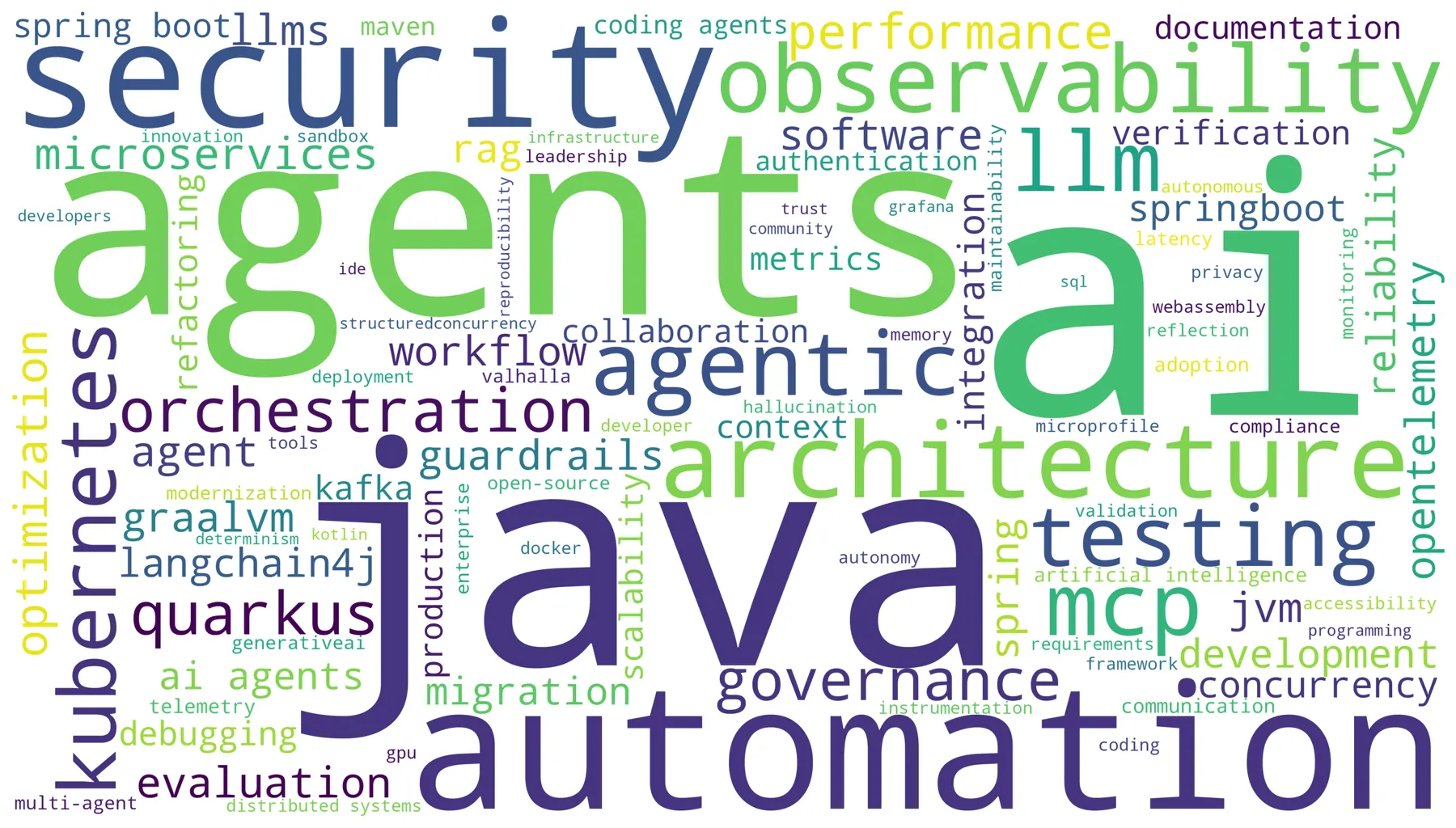
from 500 speakers · 46 countries · 305 companies
competing for 213 slots
One track took 30% of everything
Agentic Engineering & Tooling pulled 232 proposals — more than the next two tracks combined, and 5× the smallest track. That is the single loudest signal in this dataset: the community has decided where the interesting problem is this year.
AI is not a track. It is a layer over every track — except one.
Counting only titles that explicitly name AI, agents, LLMs, MCP, prompts, RAG or vibe-coding, 352 of 772 proposals carry an AI signal. Every track is somewhere between a quarter and half AI-flavoured — and then there is Java Language & Platform, sitting at 6%, quietly talking about Valhalla, structured concurrency and value classes as if none of this were happening.
The backlash has its own genre
A visible cluster of titles pushes back rather than evangelises: Cognitive Debt, Vibes Don't Scale, The hidden cost of AI coding, 3 Lies Your AI Agent Tells You in Production. Thirteen titles literally begin with the word "Stop". Year one was demos; this year is consequences.
MCP went from acronym to assumption
Sixteen titles name the Model Context Protocol outright — and notably, most are past the explainer stage: server design trade-offs, auth, toxic flows, enterprise scaling, To MCP or Not to MCP. Nobody is pitching "what is MCP" anymore.
Vibe coding is already being buried
Of the seven titles using the term, six use it as the before state: vibe coding → spec-driven, → context engineering, → harness engineering, → production system. The vocabulary moved in a single CFP cycle.
"Build your own agent" is the new "build your own framework"
Nearly a quarter of the 155 agent titles are build-it-yourself sessions, plus 17 on running agents in production and 10 on multi-agent systems. The centre of gravity has shifted from calling an API to operating a system.
Two out of three want the 50-minute stage
505 proposals ask for a standard Conference slot. The deeper formats attract far fewer takers — 36 Deep Dives, 23 Hands-on Labs — even though agentic tooling is exactly the kind of subject that rewards three hours and a laptop. 41 people put themselves forward for a keynote. As the next section shows, choosing the crowded format is a decision with consequences.
772 proposals. 213 slots. Roughly one in every 3.6 makes it.
The schedule for 5–9 October 2026 has 213 speaking slots across ten rooms and five days. That fixes the overall acceptance rate at about 28% before anyone reads a single abstract — but the odds are wildly uneven between formats, and not in the direction most people bet on.
Everyone queued for the busiest door
65% of proposals went for the standard Conference slot, where 505 people compete for 117 places. Meanwhile the Deep Dive queue is 36 proposals for 20 slots and the Hands-on Lab queue is 23 for 12. A speaker willing to prepare three hours of material had roughly two and a half times better odds than one pitching 50 minutes.
The deep formats are genuinely open
Deep Dives and Hands-on Labs together offer 32 slots against 59 proposals — a 55% and 52% acceptance rate. That is the single most useful thing in this whole dataset for anyone planning next year's submission.
The closing keynote is the hardest ticket at Devoxx
One closing keynote slot, eight proposals. Six opening keynote slots, 33 proposals. Nobody should be discouraged by that — but a keynote pitch is a lottery ticket in a way a Tools-in-Action pitch is not.
What the number really means
Around 559 proposals cannot be scheduled. Almost none of that is about quality — it is about ten rooms and five days. A "no" from this CFP is arithmetic far more often than it is judgement, and most of these talks deserve a stage somewhere.
The Benelux–France–Germany core, and a long tail of 34 more countries
Devoxx Belgium remains a European conference with global reach: 46 countries represented, but the top four supply just over half the speakers. Belgium is third — a healthy sign that the home crowd shows up without crowding out everyone else.
Beyond the AI layer, the classics held their ground
Keyword frequency across all 772 titles. "Java" still appears in 107 of them — the single most common concrete noun in the whole pile after "agent". Testing, architecture, observability and security all held steady, and a small but persistent seam of Valhalla, virtual threads and GraalVM says the platform crowd is very much still here.
305 companies, and nobody owns the room
The ten largest employers together account for just a quarter of the CFP. The biggest of them, IBM, is 4.5% — and 136 companies submitted exactly one proposal. For a conference this size that spread is the number worth protecting: it means the program is being offered by an industry, not staffed by a handful of vendors.
A Dutch bank outranks Google and AWS
ING is the fifth-largest submitter — ahead of AWS (15), Google (13) and JetBrains (13), and behind only IBM, Microsoft, Oracle and the independents. It is the one name in the top ten whose business is not selling something to developers. Rabobank, Commerzbank, Carrefour, Decathlon, TenneT, Spotify, Worldline, trivago and Wise are all in the pile too.
Nearly half the companies submitted once
136 of 305 employers appear exactly once, and 262 proposals come from companies with two or fewer. The tail is where the surprises usually hide — and where a program committee has to read most carefully, because there is no reputation attached to the logo.
"Three proposals" almost always means one person
Exactly 76 companies show up three times — and in 66 of those cases it is a single speaker filing the maximum three proposals allowed. Company count is a proxy for headcount far less often than it looks.
The densest submitter is a six-person team
Broadcom's Spring team put 16 proposals on the table from just 6 speakers — the tightest ratio in the top ten. AWS and ING sit at the other end, 15 and 19 proposals from 13 speakers each: broad participation rather than a few prolific voices. And 51 proposals are co-authored across two different employers.
Who pays for the room
772 proposals become 213 talks in a venue somebody has to rent, with coffee somebody has to buy. These 22 companies are why the ticket price is what it is. And they are not standing outside the CFP looking in: 14 of the 22 submitted proposals too — 117 of them, 15% of everything analysed on this page, all of it landing in the same pile as everyone else’s.






















Half the speakers submitted more than once — and 142 maxed out
253 of the 500 speakers submitted more than one proposal, and 142 of them filed the maximum of three. That concentration matters for the committee: the same names recur, so a decision on one abstract is rarely a decision about one person.
Co-speaking is the exception, not the rule
85% of proposals are solo. Of the 115 that aren't, 57 pair speakers from different countries and 64 pair different companies — the joint talks that do happen tend to genuinely cross a boundary rather than being two colleagues from the same floor.
The cap is doing real work
142 speakers filed all three proposals they are allowed. Without that cap the top of this distribution would look very different — and the 136 one-proposal companies in the tail would be competing against people who submitted ten.
Everyone has learned the colon
370 titles use the Hook: the actual subject construction. 68 are phrased as questions, 12 lead with an emoji. Average title length: 59 characters. Six titles were submitted twice, verbatim.
Keynote ambitions cluster where you'd expect
Of the 41 keynote and closing-keynote pitches, 11 come from the agentic track and 9 from People, Practices & Career — the two places where someone thinks they have something to say to the whole room, not just to a track.
Bluesky has almost caught X — and LinkedIn already won
The speaker profiles carry their own story. 456 of the 500 list a LinkedIn account; 208 still list an X handle; 169 now list Bluesky. 112 list both X and Bluesky — mirroring rather than moving — but 58 list Bluesky or Mastodon and no X at all, against 94 still on X alone. And 204 speakers, four in ten, list LinkedIn and nothing else.
One in nine is a Java Champion
53 bios mention the title, and 77 speakers name at least one recognition programme — Java Champion, Google Developer Expert, Microsoft MVP, Oracle ACE, AWS Hero, Docker Captain, CNCF Ambassador. A further 33 run or co-founded a Java User Group.
People rewrote their bios, not just their abstracts
Nearly four in ten bios now mention AI, LLMs or machine learning, and 84 mention agents specifically. The shift in the submission pile isn't only a change in what people are pitching — it's a change in how they introduce themselves.
This is a senior room
137 bios state a number of years of experience, and the median is 20 — a quarter of them claim 25 or more. Read it as a floor rather than an average: people mention the number when it flatters them, so the ones staying quiet skew younger.
Advocates, founders and authors
52 speakers describe themselves as developer advocates or in DevRel, 48 as founders, 40 as authors of a book, 54 as trainers or teachers, and 24 hold a PhD or call themselves researchers. Median bio length: 80 words.
The program committee
22 people now have to read every one of these proposals, discuss them, rate them, and decide which 213 make the schedule. It is volunteer work, done alongside day jobs, and it is by some distance the least glamorous part of running a conference. Each of the eight tracks has a lead who owns its shortlist; the rest of the committee reviews across several tracks at once.











Alongside the committee, a group of volunteers from the community reads and rates proposals too — extra pairs of eyes with no stake in the outcome, which is exactly the point.
Full track table
| Track | Proposals | Share | AI-flagged | AI % | Conference | Keynote | Deep Dive | Lab |
|---|---|---|---|---|---|---|---|---|
| Total | 772 | 100% | 352 | 46% | 505 | 41 | 36 | 23 |
Show all chart data as tables
| Session format | Proposals | Share | Slots | Per slot | Can be accepted |
|---|
| Country | Speakers | Share |
|---|
| Employer | Proposals | Share | Speakers |
|---|
| Social platform | Speakers | Share |
|---|
| Term in title | Titles | Share |
|---|
Method. Every figure comes from the 772 proposals in SUBMITTED state at CFP close. Track and format counts are exact. Theme figures are title-only keyword matches — they undercount, since a talk can be entirely about agents without saying so in its title, so read them as a floor, not a census. The "AI-flagged" measure matches AI, LLM, GPT, GenAI, agent/agentic, MCP, prompt, RAG, vibe, or a named assistant. Country and company come from the speaker profile, not the talk; employer names were normalised before counting, so legal-entity and spelling variants (Amazon Web Services / AWS, Oracle / Java Platform Group, the Spring team / Broadcom) are merged — 321 raw strings become 305 employers. The opening word cloud is a separate term-frequency render over the same submission set, so it reaches into proposal text the title-only counts cannot see — which is why observability, governance and guardrails loom larger there than in the bars below. Speaker-profile figures (social accounts, bio mentions, years of experience) come from the 500 submitting speakers’ own profiles and are reported in aggregate only — no individual is named, and bio counts are keyword matches over self-written text, so they measure what people chose to say about themselves rather than what is true of them. Slot counts come from the published 5–9 October 2026 schedule: 213 empty slots across ten rooms, none yet assigned to a proposal. Acceptance rates are therefore structural arithmetic — slots divided by submissions — not a prediction of any decision, and the schedule can still change. Slots carry a format but no track, so per-track odds cannot be computed from this data. Nothing here reflects review outcomes — the committee has not decided anything yet.